
Posted:
Friday, January 30, 2026
A Message from Linda Waldbaum, Newsletter Editor
As PFT members, we recognize the importance of our union to protect our rights, negotiate our contracts, and advocate for safe and respectful working conditions. But have we ever stopped to consider why our union is able to do these things? What gives us the authority to negotiate? What obligates the District to bargain in good faith? What sets the rules that govern our relationship with administration? The answer lies in the New York State Taylor Law.
Enacted in 1967, the Taylor Law established the legal framework that governs labor relations for public employees across New York State. Its central purpose is to promote stable, fair, and productive relationships between public employers and unions. At the heart of the law is a simple but powerful principle: Public employers and unions are legally required to negotiate in good faith over terms and conditions of employment.
Good-faith bargaining requires more than simply appearing at the negotiating table. The Taylor Law obligates school districts to engage honestly in discussions, share relevant information, and seriously consider union proposals with the intent to reach an agreement. Tactics such as surface bargaining, unnecessary delays, or unilateral changes to working conditions violate this obligation. These requirements ensure that negotiations are meaningful, balanced, and more than a formality.
To enforce these obligations, the Taylor Law created the Public Employment Relations Board (PERB), which is an independent state agency charged with overseeing public-sector labor relations. It investigates and rules on improper labor practice charges, determines whether parties are bargaining in good faith, resolves representation disputes, and oversees impasse resolution procedures when negotiations stall. In short, PERB is the referee that ensures both sides follow the law.
For PFT members, PERB provides accountability. If the District refuses to bargain, retaliates against union members, interferes with union activity, or violates contractual rights, the union can file a charge with PERB, which has the authority to require corrective action and enforce compliance with the law. By enforcing the language present within the document, it gives our negotiated contracts power.
The Taylor Law also protects individual members. It safeguards our right to join and participate in the union without fear of retaliation, and guarantees union representation during investigatory meetings that could lead to discipline. These protections strengthen our collective voice and ensure fairness in day-to-day workplace interactions beyond the bargaining table.
In exchange for these rights and protections, the Taylor Law prohibits public-sector strikes. Violations carry serious consequences, including loss of pay. While this restriction is significant, the law’s emphasis on structured bargaining, dispute resolution, and enforcement through PERB is intended to prevent conflicts from resulting in a strike.
The Taylor Law is the foundation that allows the PFT to function effectively. It compels good-faith negotiations, establishes enforceable rights, and provides a neutral system for resolving disputes. A strong understanding of the Taylor Law and PERB empowers us to protect our rights, perform our jobs effectively, and stand together to continually strengthen the PFT.
- https://oer.ny.gov/new-york-state-public-employees-fair-employment-act-taylor-law
- https://communicator.pef.org/issue/volume-40-no-10/understanding-the-taylor-law-and-what-could-be-considered-punishable-strike-action-for-public-employees/
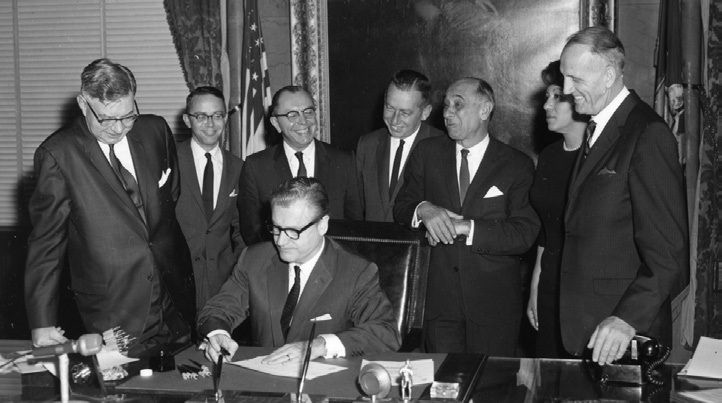
Photo: Gov. Nelson A. Rockefeller, seated, signs the Public Employees Fair Employment Act, known as the Taylor Law, in 1967. From left to right, then CSEA President Joseph Feily; Rockefeller aide and former CSEA counsel Harry Albright; state Budget Director T. Norman Hurd; Lt. Gov. Malcolm Wilson; Attorney General Louis Lefkowitz; Ersa Poston, chair of the state Civil Service Commission, unidentified woman and incoming CSEA President Theodore Wenzl. Photo courtesy of New York State Archives.
Found in: